Design
Slice of Life: Preventive Health App
Co-developed Slice of Life, a preventive health product designed to strengthen long-term well-being through intentional social connection. This project was completed in response to the 2025-2026 Stanford Center on Longevity Design Challenge focused on design solutions that empower individuals to lead healthier, longer lives through preventive health strategies.

Overview
Challenge
Busy teens and adults - roughly ages 16 to 60 - want to stay connected and engage in the activities they enjoy, but often feel like their week disappears into school, work, or other commitments.
Solution
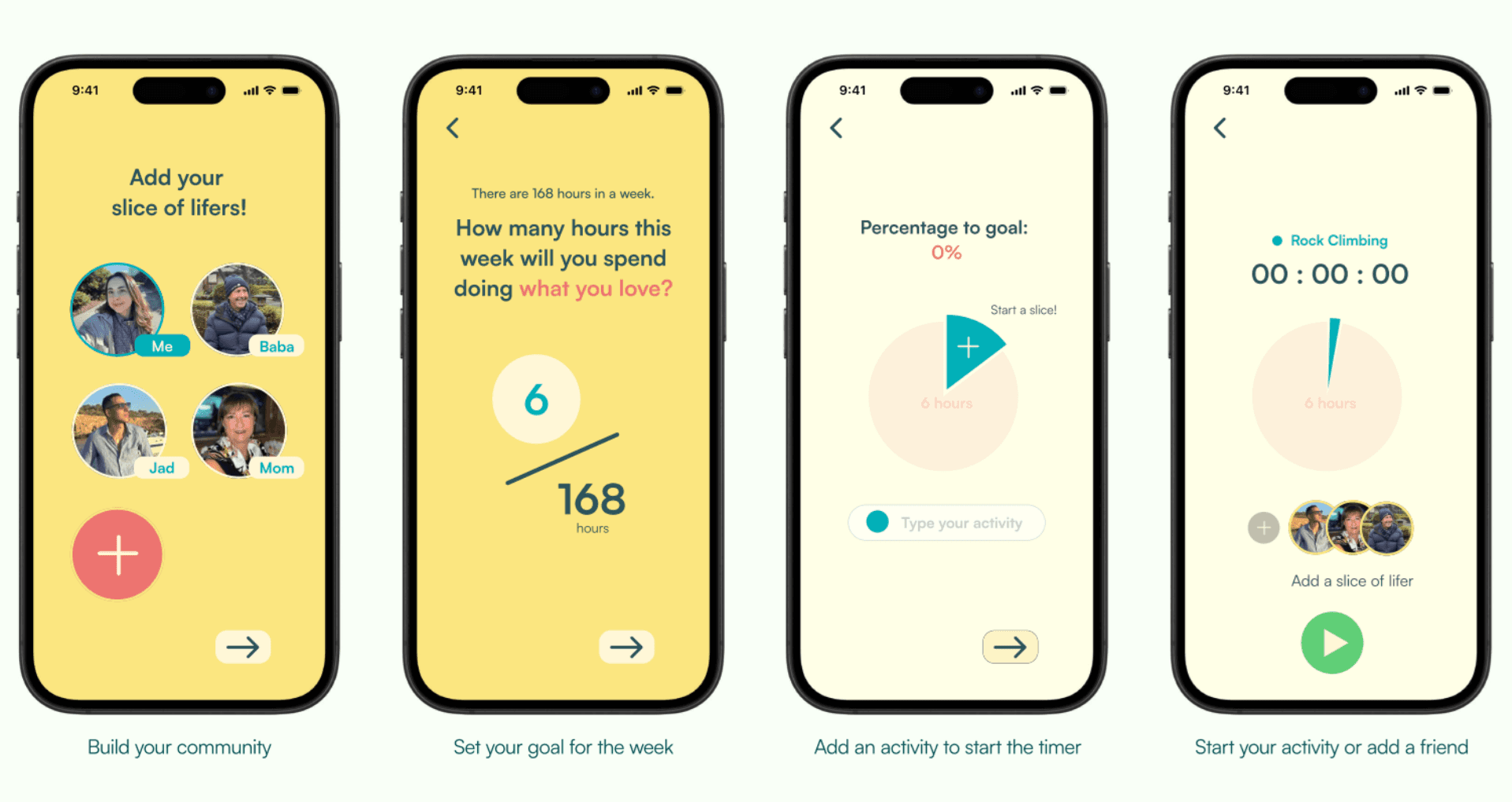
Slice of Life is a mobile app that helps people build healthier, more connected weeks by turning the time they spend on physical, mental, and social well-being into a visual “pie” they can share with the people closest to them. You download the app and create a group with your close friends or family (your “Slice of Lifers”). Then, you set a target for how many hours you want to spend on meaningful activities that week. When you’re ready to start an activity - painting, rock climbing, visiting a coffee shop, etc. - simply add your activity name and tap the play button to begin!
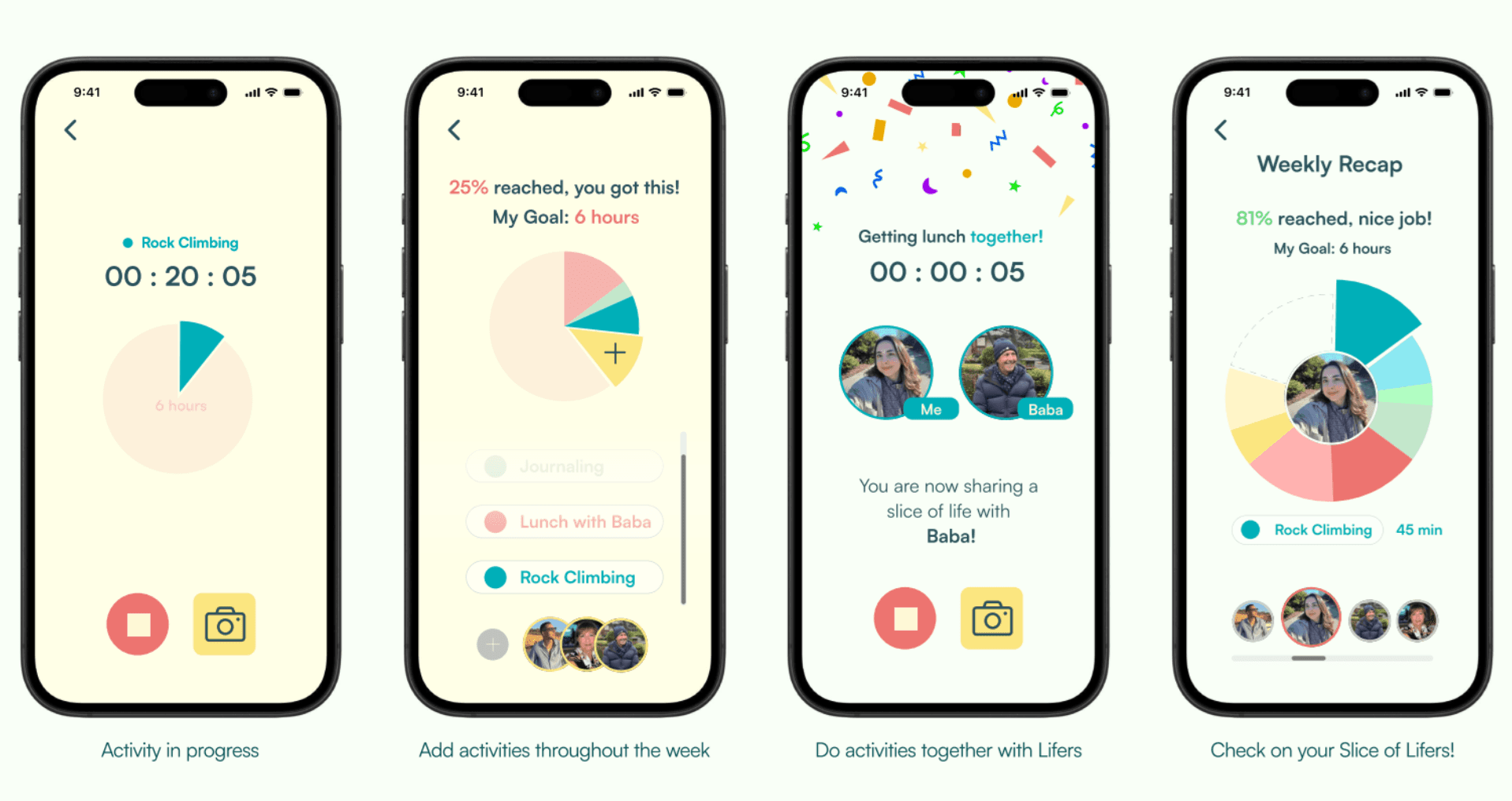
Instead of tracking productivity or streaks, Slice of Life turns moments into shared routines. “Add a Slice of Lifer” means you’re intentionally starting an activity with someone in your group, so when you invite them into that slice, their timers and pies update too. In real time, your inner circle can see how everyone is spending their week and nudge each other to join in when life gets crowded. During activities, you can also snap photos that attach to each slice, so your log becomes a timeline of memories.
Each week, the app generates a recap where you and your Slice of Lifers can see how your hours actually flowed, how often you shared slices, and how that compares to your intentions. By helping people notice where their time goes, Slice of Life helps rebalance towards close relationships and cognitively engaging activities - two pillars of preventive health that support longer, healthier lives.
Research
In order to validate Slice of Life, we began with more than 50 surveys and 8 in-depth interviews with young adults and parents to understand how they define a healthy life, when they last felt truly engaged, and why their passions and connections often fade. These conversations revealed a clear pattern: people want more meaningful time with their inner circle but lose hours to work, school, and other commitments. We reviewed research on preventive health and social connection, including findings from the Harvard School of Public Health, the U.S. Surgeon General’s Advisory on Loneliness and Isolation, and Blue Zones’ work on purpose and community. We also analyzed existing tools such as Habitica, Toggl, Strava, Nike Run Club, Fitbit, Peloton, and Headspace to understand what they address well and where they fall short in supporting small, tight-knit groups and non-fitness hobbies.
After creating our wireframes in Figma, we conducted usability tests with three potential users who fit our target audience. These sessions helped us refine key flows, including goal setting, reading the pie visualization, and recognizing icons like the plus button and the share feature. Participants highlighted when labels were unclear or visuals were confusing, which guided changes in language, color consistency, and hierarchy. Each round of feedback informed updates that ensured Slice of Life feels intuitive, motivating, and grounded in real user needs.

Tight-knit community.
Other apps can feel isolating with large, anonymous communities that are disconnected. Our research shows that tight-knit communities promote real moments that are fun and memorable.
A more balanced you.
Building consistency.
Design
We synthesized qualitative and quantitative user data into actionable product strategy, uncovering time scarcity, lack of accountability, and over-individualized wellness tools as primary retention challenges; we translated insights into user needs, jobs-to-be-done, and differentiated engagement principles.
I co-led UX iteration and product definition in Figma, refining onboarding, goal-setting, and social interaction flows through live usability testing; we intentionally removed streaks, leaderboards, and productivity-driven mechanics to improve long-term engagement and reduce user drop-off.
We directed competitive analysis, MVP planning, and go-to-market strategy by evaluating wellness and habit-tracking platforms, defining a differentiated positioning around small real-world social circles, and outlining 4-6 week pilot cycles, engagement KPIs, and a scalable freemium monetization model.
By combining connection and meaningful activity in one place, Slice of Life addresses preventive health in ways that existing tools do not.
We plan to sell our app directly to consumers. Our primary users are close friends, families, and tight-knit groups who want a simple way to stay emotionally connected. A B2C approach allows users to discover, share, and adopt the app naturally within their social circles, while giving us direct insights into user behavior and enabling faster iteration.
As a core part of the app, we also plan to generate revenue through partnerships with companies and bundled experiences. By collaborating with brands and local experience providers, we can offer curated deals that reward group engagement, such as movie nights, classes, or activities that encourage users to spend intentional, high-quality time together. This approach ensures that both adoption and monetization remain closely tied to the app’s core purpose which is to foster meaningful social connections.
12 months post-launch of our MVP, we aim for 50,000 active users, with an estimated 4% choosing a paid tier (2,000 paying users). At that scale, these price points generate $17,000/month in subscription revenue - enough to cover development and basic operating costs while keeping prices realistic for students and families.
To reach our target audience, we will roll out Slice of Life in phases, starting where shared routines and friendships are already strong: college campuses. In Phase 1, we will beta test with small groups of students who already spend time together - roommates, dance teams, club boards - to gather feedback on usability, design, and which features actually change behavior. After refining the app, we’ll expand through word-of-mouth and built-in virality: when users share their weekly “slices” and photo snapshots in group chats, they naturally invite others to join their Slice of Lifers circle. Since the core app is free, the barrier to entry is low for students and young adults. We will pair this with a clear brand identity built around “sharing a slice of your life,” positioning the app as an easy, visual way to track meaningful time doing what you love, with the people you love. We will also partner with small student groups within campus organizations like residence halls and clubs to host weekly challenges where groups set goals and activities for the week, and share their pies at the end of the week. Over time, we will layer in playful brand partnerships that reinforce prevention-focused, social habits such as “Share a Slice of Life at Chili’s,” where users who log a shared slice at the restaurant receive a small discount.
Results
Created a video and presentation deck that showcases our work concisely.
Designed the mobile app screens in Figma:
Today, people turn to habit trackers, time logging tools, and fitness apps to manage their routines. Apps like Habitica and Toggl help users build habits and track their time, but they are designed around productivity, streaks, and work. They function as personal logs and notification systems rather than tools that actively foster shared, meaningful moments with others. On the other side, platforms like Strava, Nike Run Club, Fitbit, Peloton, and Headspace focus on specific wellness domains, mostly physical fitness or meditation, and often center around large, semi-anonymous online communities or leaderboards. You might follow people, but you do not necessarily know them well in real life, which can still feel isolating.
Slice of Life is different because it is built around your real inner circle, the friends and family you actually spend time with. Moreover, it encourages joyful, engaging, and social activities: board games, long walks, hobbies, creative projects, and more. Instead of just tracking behavior, Slice of Life helps you and your circle intentionally decide how much of your week you want to devote to these moments and then spend that time together. It is designed to strengthen genuine relationships and create sustainable weekly habits that contribute to long-term well-being.